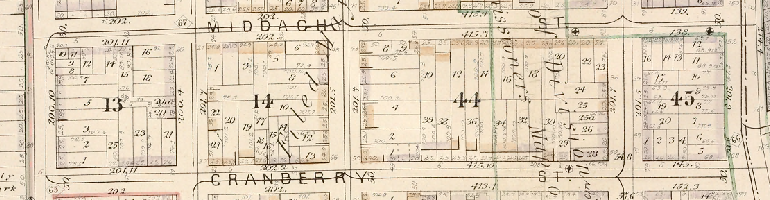

Charlotte Charlaque was one of the three people who first had gender affirmation surgery, beginning in 1928 in Berlin. Her birth name in 1892 was Curtis Scharlach. Her family moved from Germany to the US in the early 1900s and she became a US citizen after her father was naturalized. By World War I, she was living in New York and spelled her last name Charlaque. She returned to Germany in the 1920s and adopted the first name Charlotte. She worked as a translator, sang and acted, and became affiliated with the Institute for Sexual Science run by Magnus Hirschfeld, who later performed her surgeries.
Her Jewish and transgender identity led Charlotte and her partner Toni Ebel to flee the Nazi rise to power in Germany in the early 1930s. They moved to Czechoslovakia. In 1942, Charlotte was arrested in Prague for being Jewish. Toni saved Charlotte by showing evidence of her American citizenship, and she was eventually deported to the US rather than being sent to a concentration camp. Ebel remained in Europe, and though the pair maintained contact after the war, they never reunited.
Back in New York, Charlotte lived in several locations in Greenwich Village before moving to Brooklyn Heights in the 1950s. She was said to have been in poor health, with little money. Charlotte was active in theater as an off‑Broadway actress and singer. She used a variety of names both on stage and in everyday life, often known as Charlotte Curtis but sometimes going by Charlotte von Curtius. In this period, she often recast her European background: in a Social Security filing, she listed her mother as Contesse J. DeMayence, and she penned an article about gender affirmation surgery under the pseudonym Carlotta, Baronin von Curtius.
In Brooklyn Heights, Charlotte lived at 57 Middagh Street, the now-demolished Hotel Margaret at 97 Columbia Heights, and the Pierrepont Hotel at 55 Pierrepont Street. She was a well-known figure in the neighborhood. At her death in 1963, the Brooklyn Heights Press ran a front-page obituary under the headline, “Death Ends Proud Reign Of The Promenade’s Queen.” The article freely admitted Charlotte’s flamboyant appearance and demeanor blurred the line between fact and fiction in her biography. But if the writer or her Brooklyn neighbors knew she was transgender, the story didn’t give any hint. In any case, as a relative recently wrote, Charlotte “died the beloved leader of a close-knit community who appreciated her in life and honored her in death.” The Rev. William Glenesk of Spencer Memorial Church on Remsen Street led her funeral, and her ashes were said to have been scattered from the Promenade.
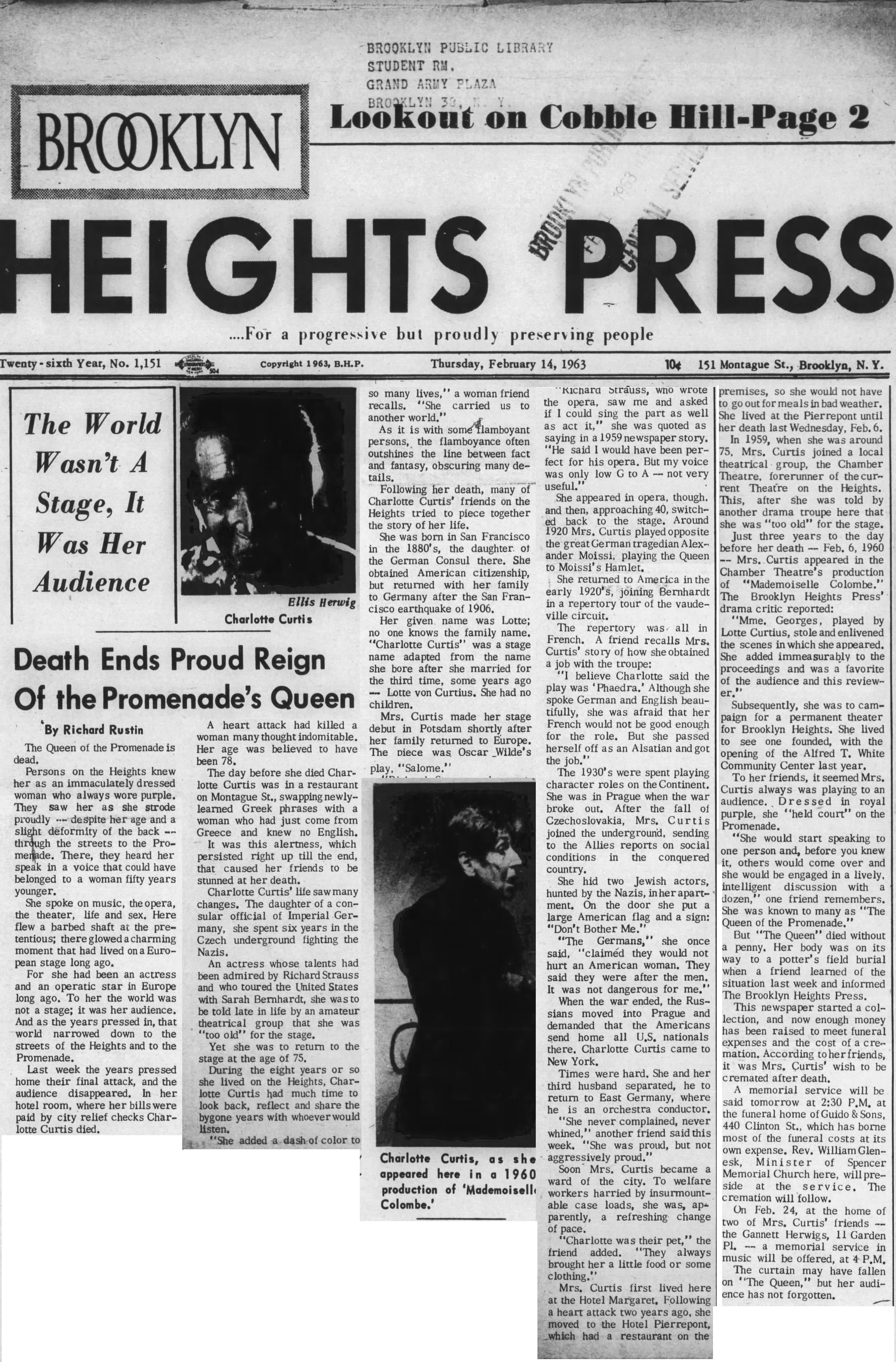
In the last few years, new research, in Hirschfeld’s archives in Berlin and US projects devoted to queer history, have revealed Charlotte’s story. Raimund Wolfert wrote a German-language biography of Charlotte called “Queen of the Promenade” and the NYC LGBT Historic Sites Project has continued to shine new light on her time in New York City. Today, Charlotte is recognized as a pioneering figure in New York City’s post-World War II queer community.
Photo 1: circa 1940 from Czech National Archives via Jewish Women’s Archive
Photo 2: Brooklyn Heights Press, February 14, 1963 via Center for Brooklyn History – Brooklyn Public Library
 Old Brooklyn Heights